

Why This, Why Now?
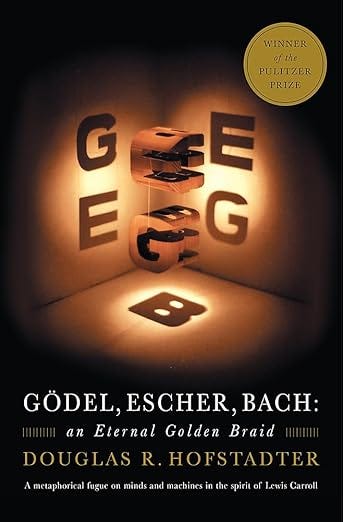
When I was 16, I found a copy of Douglas Hofstadter’s Gödel, Escher, Bach (G.E.B) in my high school library. Whatever I had been looking for that day was instantly forgotten. The book is long and complex, and I didn’t understand most of it at the time. But that didn’t matter. I was hooked. Artificial Intelligence had captured my imagination.
Even the name sounded futuristic and full of possibility. I had already fallen in love with computers, spending hours playing games and writing simple programs (you guessed it, I was one of the popular kids). But AI felt like something bigger. It felt like the future.
My Early AI Journey
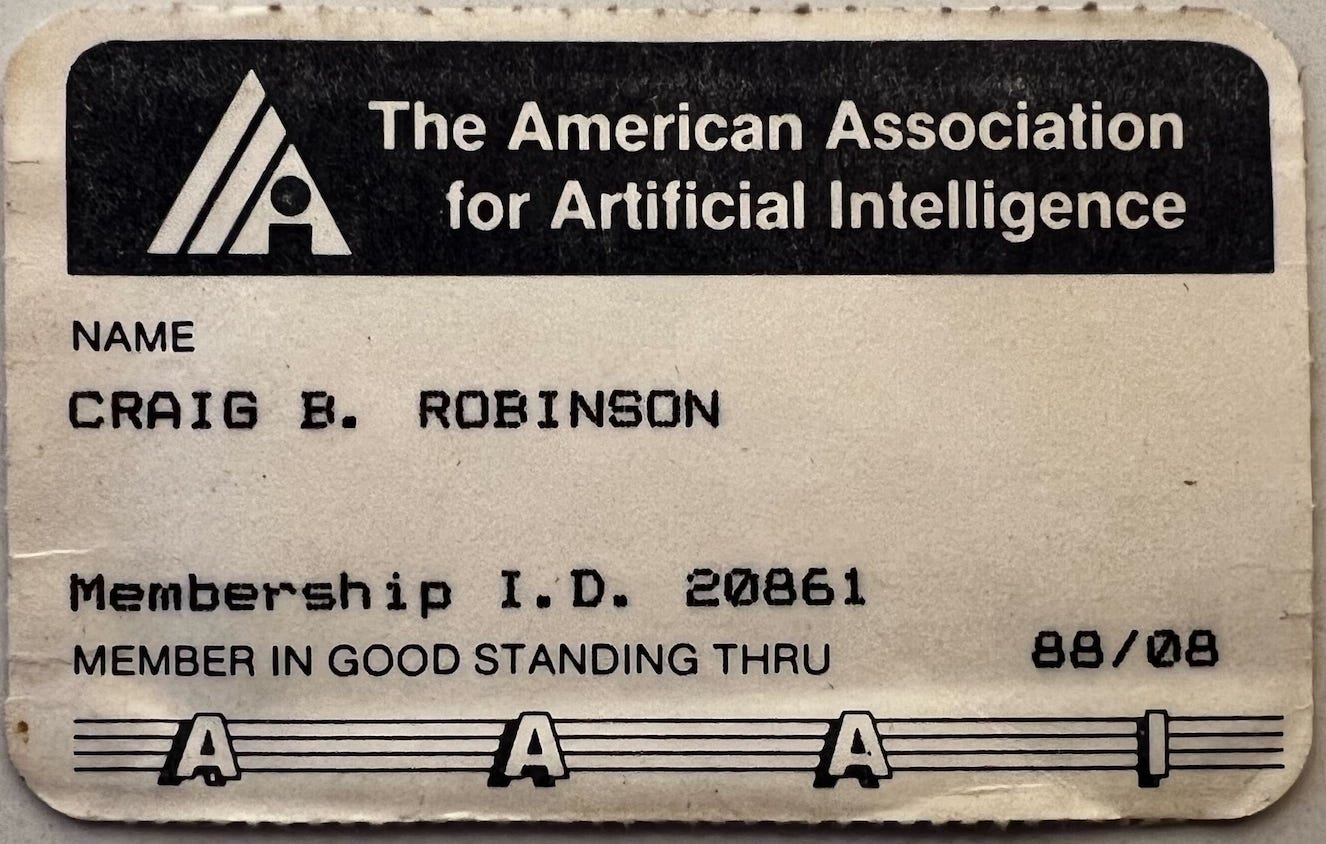
I devoured everything I could find on the topic. Inspired by G.E.B, I wrote a high school thesis on Alice in Wonderland as a formal system. In 1987, when Seattle hosted the Sixth National Conference on Artificial Intelligence (AAAI-87), I attended as a 17-year-old neophyte and became a member of, what was then called, the American Association for Artificial Intelligence.
My college entrance essay was a parable about an AI that ran out of storage space and realized it only needed to remember what truly mattered.
At Northwestern University, I studied Computer Science, Neuroscience, and Psychology. I worked on early AI projects, including training a rudimentary neural network to perform word stem completion on a NeXT cube.
While I was there, Northwestern recruited Roger Schank and his team from Yale to launch the Institute for the Learning Sciences (ILS), a major coup in the AI research community.
Then Everything Stalled
By the early 1990s, progress in AI slowed. The field entered what is now known as the AI Winter. Symbolic methods, which had dominated for years, were no longer delivering meaningful results. Researchers were exploring neural networks, but computing power was still limited. Learnings from The Bitter Lesson were decades away.
Funding disappeared. Interest waned. Industry jobs dried up. I pivoted to other areas, working in 3D graphics, medical imaging, and multimedia, and eventually found my way into the games industry, where I’ve spent the last two decades.
Still Watching & Learning
Even as I moved away from AI professionally, I never stopped following it. I watched as advances in GPUs and scalable computing led to a new era of deep learning.
In 2017, I built AI/ML systems for churn and payer prediction in games. And over the past five years, I’ve experimented with almost every new AI model or tool I thought could be relevant to game development.
It’s now clear that AI is transforming every industry. Game development will not be an exception. Two of my greatest interests, games and AI, are colliding in a big way.
That’s why I’m launching this newsletter.
What to Expect Here
This newsletter is for developers, designers, technologists, and creatives who want to understand how AI is reshaping the world of games.
You can expect:
Practical insights into AI tools for code, assets, and workflows
Breakdowns of new research, models, and trends
Updates on laws and policies impacting games and AI
Thoughtful discussion of workforce and studio changes
Above all, I want to build a community, one that shares knowledge, asks good questions, and explores both the opportunities and the challenges that come with these changes.
Let’s Explore Together
If you work in games, or want to, and you’re curious, excited, or overwhelmed by what AI might mean for your work, I hope you’ll subscribe.
This is just the beginning, and there’s a lot more to come.